
Greeted in London: Discovering Fitzrovia
When my partner and I planned a December trip to London—one of my favorite cities, especially at Christmastime—we decided to add a Greeter walk.
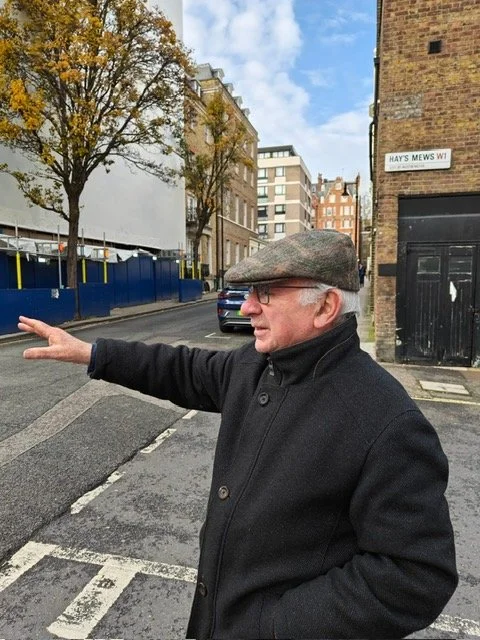
I'd lived in London years ago and assumed I knew it fairly well. But there's nothing like exploring with a local to make a familiar city feel new. London Greeters pairs visitors with residents to discover lesser-seen corners, much as our program does in New York.
I submitted a request through the London Greeters website and received an email from Paul Olins.
Paul has been a Greeter for more than a decade and now is the head of the London program. He suggested we meet in his own neighborhood: Fitzrovia. Despite my time in London, I’d never properly explored this pocket of central London tucked between Oxford Street and Euston Road, with Bloomsbury to the east and Marylebone to the west. It’s right in the heart of things, yet I’d somehow missed it.
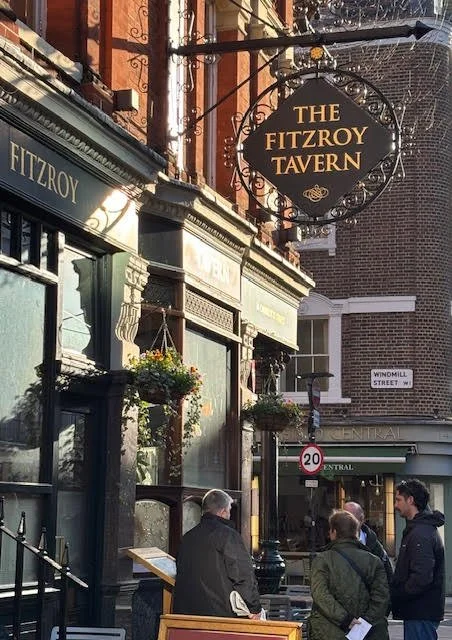
We met at the Fitzroy Tavern on Charlotte Street, which was alive with that particular pre-Christmas energy London does so well. We felt so happy to be there!
Paul greeted us warmly and, almost immediately, launched into Fitzrovia’s backstory, starting with the name itself. “Fitzroy,” he explained, comes from the Norman French “fils du roi”—son of the king—and traces to Henry FitzRoy, an illegitimate son of Charles II who became the 1st Duke of Grafton. His descendants helped shape the area through marriage, inheritance, and development.
The tavern made an apt prologue. Long associated with Fitzrovia’s bohemian reputation, it has been a gathering place for writers and artists: Dylan Thomas and George Orwell among the names most often linked to it.
Fitzroy Square: Georgian Dreams and Economic Reality
From the pub, Paul took us around the corner to Fitzroy Square, the neighborhood’s Georgian centerpiece. In the 1790s, Charles FitzRoy, 1st Baron Southampton—great-great-grandson of Charles II—commissioned Robert Adam to design an elegant speculative development for London’s aristocratic families.
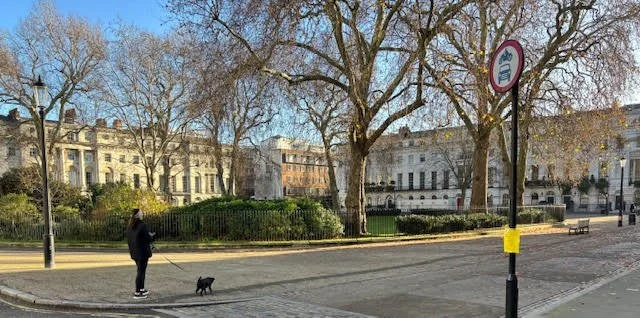
Paul pointed out details that bring the square’s history into focus. Some façades were finished in Portland stone, shipped from Dorset—a statement of ambition (and cost). Later phases relied more on stucco: still graceful, but more economical.
Wars, economic disruption, and a property slump slowed progress and shifted the market. When building resumed, the aristocracy was already drifting toward newer addresses. Fitzroy Square kept its elegance, but the social center of gravity had moved.
From Aristocrats to Artists
What might have looked like a setback became part of Fitzrovia’s defining character. As wealth favored other districts, many grand Georgian houses were subdivided into lodgings and workspaces, conditions that later suited writers, artists, and independent-minded professionals.
That creative lineage is written into the square. George Bernard Shaw lived at No. 29 in the late 1880s and 1890s, and Virginia Woolf later occupied the same building in the early 1900s. Blue plaques mark other residents too, including Prime Minister Lord Salisbury and the artist Ford Madox Brown.
Fitzrovia’s cast of characters doesn’t stop there. James McNeill Whistler lived here, and novelist Ian McEwan later made the area part of his London landscape. We even learned that Monty Python had offices nearby in the 1970s. I couldn’t help picturing John Cleese doing his silly walk across the square.
Fitzrovia still carries that creative undertone, even as it adapts to contemporary London. Charlotte Street has evolved into a bustling restaurant corridor, and just to the west, the BBC’s Broadcasting House anchors the wider area’s media presence.
The Greeter Connection
It was clear Paul knows Fitzrovia inside out and genuinely enjoys sharing it. He offered to show us more, but we had to leave for another engagement.
Still, we felt privileged to have walked in the footsteps of so many remarkable figures. Fitzroy Square has enough drama and notable characters to fill a Julian Fellowes series.
Thank you, Paul, for a wonderful greet. And when you find yourself in New York, we’ll be delighted to return the favor.