
Layers, Landmarks, and New Friends: A First-time Visit to New York
Ayda Sandoval was excited to make her first trip to New York to attend the 150th annual Westminster Kennel Club Dog Show at Madison Square Garden in early February.
After arranging a week-long break from teaching high school students in southern Arizona, Ayda set up a Greet with volunteer Joan Lunoe.
And then she saw the forecast for record cold temperatures on the East Coast.
No problem! Joan and Ayda had a phone conversation about how to dress for a New York winter (Joan recommends layers) and what Ayda wanted to see while she was in town. Thanks to their call, Ayda and Joan were already friends by the time they met in person on a frigid Sunday. The weather did lead to a few changes in plan, including moving their meeting time from mid-morning to early afternoon. But sporting layers of clothing and enjoying bright blue skies, the pair headed out to explore a bit of New York.
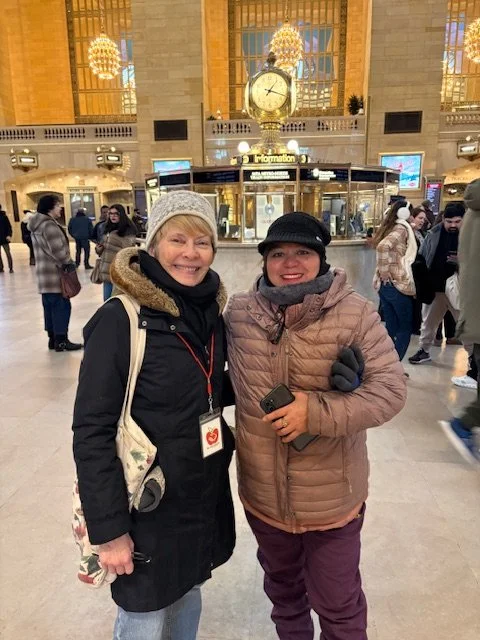
A short walk from Ayda’s hotel took them to Grand Central Terminal, one of the city’s two main railroad stations with Metro-North trains serving areas north of NYC and the Long Island Railroad sending trains to the east.
The current building opened in 1913 and features shopping and dining options. The information desk on the main concourse is topped by a four-sided brass clock, and “under the clock at Grand Central” has been a popular meeting place for more than a century. The concourse’s celestial ceiling shows numerous stars and planets in a beautiful, though not entirely accurate, depiction of the night sky. Joan took Ayda to the “whispering gallery,” a domed intersection of walkways on the station’s lower level. Stand in one corner of the archway, and even the faintest whisper will be heard by someone standing in the opposite corner.
From Grand Central, Joan and Ayda took the 4 express subway to Bowling Green at the southern tip of Manhattan.
Exiting the station at The Battery, Joan pointed out the view of the Statue of Liberty across New York Harbor. The 25-acre Battery was name for artillery batteries that protected Fort Amsterdam, built in 1626 to serve as administrative headquarters of the Dutch West India Company. Today, visitors enjoy public gardens, a carousel, and several monuments to the area’s history. Those monuments include Castle Clinton, built initially to protect against a potential British invasion in 1812. To experience New York Harbor, hop on one of several ferries that travel from The Battery to Staten Island, Ellis Island and the Statue of Liberty, and Governors Island.
A short walk up Broadway took Ayda and Joan to Bowling Green.
The oldest park in the city, the site was originally used as a council ground by Native Americans and later served Dutch settlers as a cattle market and parade ground. A statue of King George III in the park was toppled in 1776, melted into two tons of metal, and turned into musket balls for the Continental Army. The fence around the park is the original barrier, but a close look shows where supporters of the new nation sawed off the crowns that originally decorated the fence posts to add them to the metal that was turned into munitions.
Directly opposite the park, the National Museum of the American Indian, part of the Smithsonian Institution, is located in the Alexander Hamilton US Customs House at One Bowling Green. Built in the early 20th century, the building houses New York’s Bankruptcy Court and the National Archives, in addition to the free museum. The building may look familiar to moviegoers, since it’s been featured in such films as Inside Man and Black Swan. Joan was working across the street when Ghostbusters II used the building as the fictional Manhattan Museum of Art, and leaving work one day she was handed a noisemaker and ended up in a crowd scene celebrating New Year’s Eve.
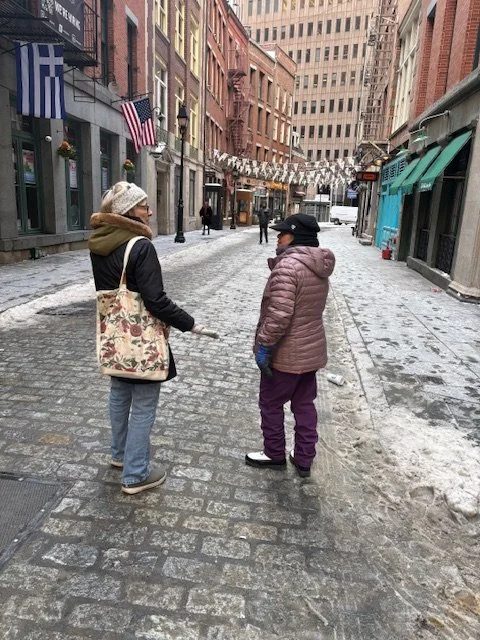
A walk along Wall Street was next on the agenda with stops at two iconic pieces of public art: the Charging Bull and Fearless Girl statues.
Joan led Ayda to Stone Street, a pedestrian-only cobblestone street in the Financial District that was home to NYC’s first breweries. Numerous bars and restaurants line the street and patrons enjoy eating and drinking at outdoor tables—weather permitting.
Next stop: Fraunces Tavern at the corner of Pearl and Broad Streets, built in 1719 as a private home. It became a tavern after Samuel Fraunces purchased the building in 1762 and later was a frequent meeting place for American revolutionaries, including Alexander Hamilton and Aaron Burr, who dined there together a week before their duel. The site now includes both a museum and a modern pub.
Ready for a break and hoping to warm up a bit, Ayda and Joan stopped in Conwell Hall on Hanover Street.
From there, it was on to the site of the original World Trade Center buildings. The National September 11 Museum is open every day but Tuesday. The outdoor Memorial Plaza is open every day and features reflecting pools in the footprints of the Twin Towers.
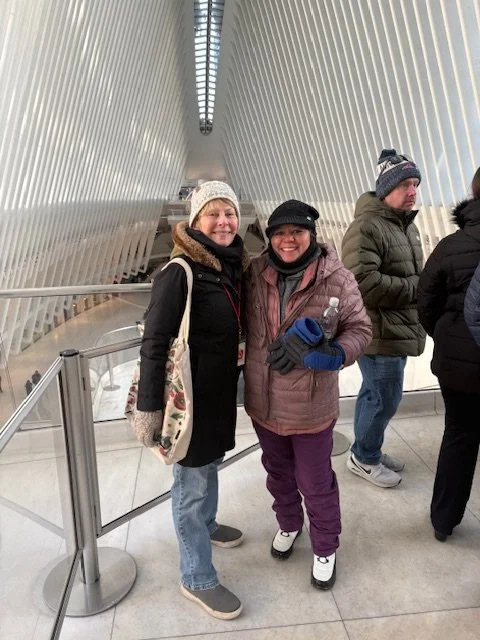
The Oculus transportation hub across the street from the memorial was designed by Spanish architect Santiago Calatrava. Built of white metal-clad steel, the structure symbolizes a hand releasing a dove. In addition to dozens of retail shops, the Oculus serves 12 subway lines and the PATH trains to and from New Jersey.
From the Oculus, Ayda and Joan took a 4 train back to Grand Central, but that wasn’t the end of the Greet. Joan walked Ayda to her hotel while making sure she knew how to get from the hotel to the dog show. The way one friend looks after another.